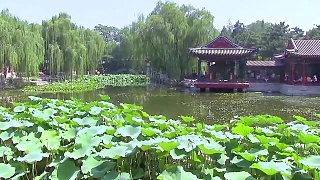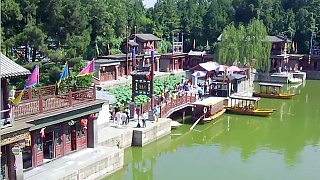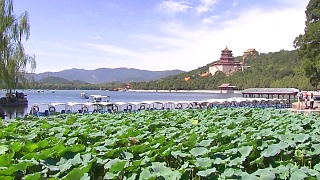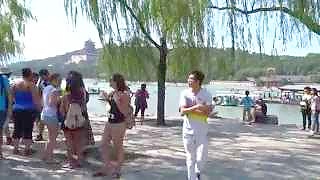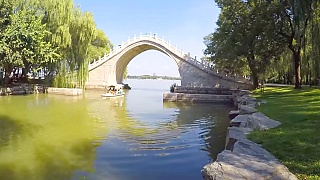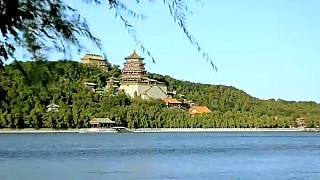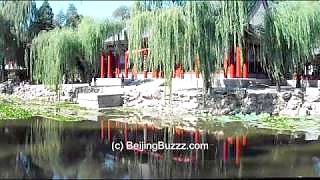
The Garden of Harmonious Interests, the Summer Palace 頤和園, BeiJing

A delightful garden within a garden.


New HD version; filmed in August 2010.


[640],shadow=true,start=,stop=

Beijing, the capital city of China, is a vibrant metropolis steeped in history, culture, and modernity. Here's a brief overview of what you can expect as a tourist in Beijing:

Historical Landmarks:
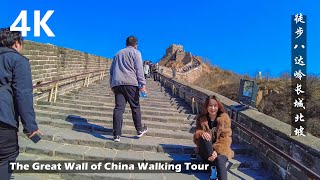
The Great Wall of China: One of the most iconic structures in the world, the Great Wall is easily accessible from Beijing. Mutianyu and Badaling sections are popular among tourists.

Forbidden City (Palace Museum): A UNESCO World Heritage Site, this vast imperial palace complex was home to Chinese emperors for over 500 years. It houses numerous halls, courtyards, and historical artifacts.

Temple of Heaven: A masterpiece of Chinese architecture, this ancient temple complex served as a place of worship for emperors to pray for good harvests.

Summer Palace: A stunning ensemble of lakes, gardens, and palaces, the Summer Palace served as a retreat for emperors during the Qing dynasty.

Tiananmen Square: One of the largest city squares in the world, Tiananmen Square is flanked by important landmarks such as the Monument to the People's Heroes, the Great Hall of the People, and the Mausoleum of Mao Zedong.

Cultural Sites:
Beijing Hutongs: Explore the narrow alleyways and traditional courtyard residences of Beijing's historic neighborhoods. You can take a rickshaw tour or simply wander around on foot.

Beijing Opera: Experience traditional Chinese opera performances at venues like the Liyuan Theater or the Chang'an Grand Theatre.

798 Art District: A hub of contemporary art and culture, this former industrial area is now home to numerous galleries, studios, and cafes.

Modern Attractions:
Olympic Park: Visit iconic structures such as the Bird's Nest (National Stadium) and the Water Cube (National Aquatics Center) from the 2008 Beijing Olympics.

CBD (Central Business District): Marvel at the futuristic skyline of Beijing's modern business district, which includes landmarks like the CCTV Headquarters and the China World Trade Center Tower III.

Culinary Delights:
Peking Duck: Indulge in Beijing's most famous dish, crispy roast duck served with pancakes, scallions, and hoisin sauce.

Street Food: Explore the city's vibrant street food scene and sample local delicacies like jianbing (savory crepes), lamb skewers, and dumplings.

Practical Tips:
Transportation: Beijing has an extensive public transportation system, including the subway, buses, and taxis. However, traffic can be heavy, so plan your travels accordingly.

Language: While English is not widely spoken, especially outside tourist areas, many signs and transportation announcements are in English. It's helpful to carry a translation app or a phrasebook.

Weather: Beijing experiences four distinct seasons, with hot summers and cold winters. The best times to visit are spring (April to June) and autumn (September to October) when the weather is mild and comfortable.

Etiquette: Respect local customs and traditions, such as removing your shoes before entering someone's home and using both hands to pass or receive items.

Beijing offers a rich tapestry of experiences for tourists, blending ancient heritage with modern innovations. Whether you're fascinated by history, culture, or culinary delights, there's something for everyone in this dynamic city.
Related Videos


Featured Videos

EMei Shan 峨眉山, SiChuan province, in Ultra HD / 4K
Emei Shan (Emei Mountain, 3,099 m / 10,167 ft) is one of the four Chinese Buddhist sacred mountains. Emei Shan is a UNESCO World Heritage Site (together with the nearby LeShan Giant Buddha) as "an area of exceptional cultural significance as it is the place where Buddhism first became established on Chinese territory ... The first Buddhist temple in China was built on the summit of Mount Emei in the 1st century CE ... Mount Emei is also notable for its exceptionally diverse vegetation, ranging from subtropical to sub-alpine pine forests. Some of the trees there are more than 1,000 years old." Included in this beautiful film : the summit of Mount Emei, WanNian Si Temple, QingYin Ge and BaoGuo Si Temple.
A selection of traditional Chinese music and song …
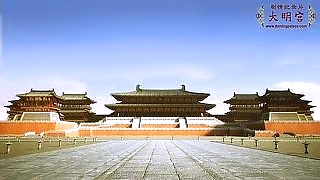
The first film is from the CCTV Spring Festival Gala 2013, with singer Na Ying. The song : [Because of You, My Life is] A Warm Spring With Blooming Flowers. In 2015, the Spring Festival (Chinese New Year) runs from the 19th to the 25th February. The second is from China's National Games Opening Ceremony in 2009. The song is Like A Dream. The third film features the music 'Legend of Chinese Mountains' and is about the five sacred mountains of China and the Chinese love of nature and balance with nature. Fourth is 'Your Collar', a romantic song from the imperial music of the Han Dynasty. Fifth song is 'A Nation of Greatness and Courtesy' and is about the Chinese character of virtue and friendship. Greatness in Chinese thinking is virtue; all three core Chinese philosophies - Taoism, Buddhism and Confucianism - stress that strength and happiness (well-being) lies in balance, not power (dominance). The last film features music from a documentary about the DaMing Palace (DaMing Gong) of the Tang Dynasty, at the heart of the dynasty's capital Chang'An (which means 'eternal peace'). The palace area is a little north east of the city of Xi'An in ShaanXi province.
Around SuQian 宿迁, JiangSu province
SuQian is a city with a cultural history of 2,500 years. The earliest use of the name was in 762 A.D. during the Tang Dynasty. The city is located on the North JiangSu Plain, with a highest elevation of 71 m over sea level and the lowest 2.8 m only. The elevation is gradually reduces along northwest to southeast. SuQian is abundant in water resources and the water surface area is close one third of its total land mass. There are two freshwater lakes in SuQian, Lake HongZe, which is one of the four largest freshwater lakes in China, and Lake LuoMa. Four rivers run through the city, including the the Grand Canal. Agriculture, including aquatic produce, accounts for about 25% of the area's economy. The population is around 5 million. Attractions include : * LuoMa Lake Scenic Area: Situated in the northwest of the city, it covers a total area of 375 square kilometers (145 square miles), dotted by many natural scenic spots and historical sites. * QianLong Temporary Palace: Named after the esteemed Qing dynasty emperor, this is a well-preserved building complex on the south bank of LuoMa Lake. It was first built around 1684. * ZhangShan Forest Park: 7 kilometers (4.3 miles) north of the city, the park has a beautiful mix of mountain and water landscapes.
Dream of Red Mansions – classical garden in NanJing, JiangSu province
Dream of the Red Chamber or The Story of the Stone is a Chinese novel composed by Cao XueQin in the mid-18th century. With Middle Kingdom Productions ... Bonus film - a Vertical Forest architecture in NanJing ...
DaLi, YunNan province trip
With Willene Business & Lifestyle ... Bonus film - with Seiu Travel ...
First time in LiJiang, YunNan province
With Soph ...
LiJiang 丽江 and DaLi 大理. YunNan province
The 'old towns'. We begin with an Ultra HD (4K) video of Dali Old Town and the nearby Three Pagodas ...
How thoughts make you unhappy
While thought can be a great tool, one can be controlled by ones thoughts rather than the reverse; that is, a slave to one's past experiences and how that projects into the future like a railway track. To be endlessly controlled by the past, and the past's plans for the future, is to die without having really lived. How to calm the noise in your mind. With Eckhart Tolle ...
The main pavilions at the ShangHai 上海 World Expo – video
The China pavilion and the Urbanisation pavilion. 'Better City, Better Life' : 1st May to 31st October 2010.

Tag search ?