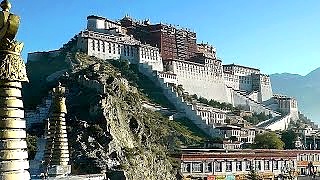
The Potala Palace in Lhasa

[640],shadow=true,start=13,stop=

The Potala Palace was named after Mount Potala, the abode of Chenresig or Avalokitesvara. The Potala Palace has in the past served as the chief residence of the Dalai Lama. Today, the Potala Palace is a museum.


Lozang Gyatso, the 'Great Fifth Dalai Lama', started construction of the Potala Palace in 1645 after one of his spiritual advisers, Konchog Chophel (d. 1646), pointed out that the site was ideal, being situated as it is between Drepung and Sera monasteries and the old city of Lhasa. It may overlay the remains of an earlier fortress, called the White or Red Palace, on the site built by Songtsen Gampo in 637.


The building measures 400 metres east-west and 350 metres north-south, with sloping stone walls averaging 3 m in thickness, and 5 m (more than 16 ft) thick at the base, with copper poured into the foundations to help protect it from earthquakes. The thirteen stories, containing over 1,000 rooms, 10,000 shrines and about 200,000 statues, soar 117 metres (384 ft) above the top of Marpo Ri, the "Red Hill", rising more than 300 m (about 1,000 ft) in total above the ground. (based on Wikipedia)
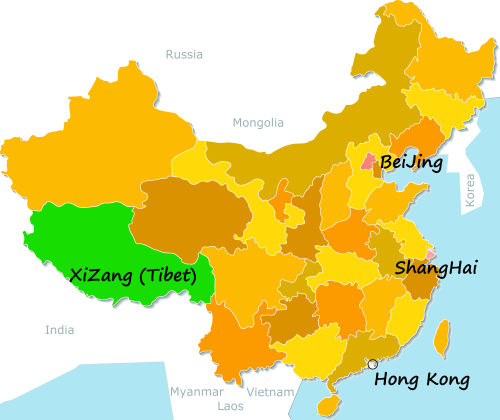
Tibet map

Related Videos


Featured Videos

The ‘Plank Walk’ at HuaShan 华山 mountain – video
In ShaanXi province.
The beautiful Temple of Heaven 天坛, BeiJing
This film focuses on the three main structures, including the Hall of Prayer for Good Harvests ...
Fermented soybeans (GuiZhou style) 貴州傳統風味
The ancient HuaYan, FaHua, HunYuan & ShanHua temples, DaTong, ShanXi province
With Andy see the World ... *** HuaYan Temple, located in DaTong, ShanXi province, is a magnificent example of Buddhist temple architecture and one of the best-preserved temples from the Liao and Jin dynasties. Its name, "Huayan," is derived from the Huayan Sutra, an important scripture in Chinese Buddhism, reflecting the temple's strong connection to the Huayan school of Buddhist thought. Key Features: Divided Structure: The temple is unique as it is divided into two parts: the Upper Temple and the Lower Temple. The Upper Temple, built on a hill, was primarily used for religious ceremonies, while the Lower Temple served as a residential and study area for monks. Grand Hall: The Great Buddha Hall in the Upper Temple is one of the largest remaining halls of its kind from the Liao dynasty. It features massive wooden beams, intricate carvings, and large Buddha statues that exude a sense of serenity. Murals and Sculptures: The temple is renowned for its well-preserved murals and Buddhist sculptures. These artworks depict scenes from Buddhist scriptures and stories, reflecting the artistic style and religious devotion of the era. Library of Sutras: The Lower Temple houses a library of Buddhist sutras, emphasizing the temple’s role as a center for learning and spiritual practice. Architectural Significance: The wooden structures of Huayan Temple showcase the advanced engineering and architectural techniques of ancient China. The use of dougong brackets (interlocking wooden brackets) is particularly impressive. Cultural Heritage: Huayan Temple is a testament to the flourishing of Buddhism in northern China during the Liao and Jin dynasties. It represents a blend of religious, artistic, and architectural achievements. Atmosphere: Visitors often find the temple serene and spiritually uplifting, with its quiet courtyards, ancient trees, and the scent of incense enhancing the experience. It is not just a historical site but also an active place of worship. Huayan Temple remains a significant cultural and spiritual landmark, drawing visitors and scholars from around the world to explore its beauty and historical importance. *** Shanhua Temple, located in Datong, Shanxi Province, is a stunning example of Chinese Buddhist architecture and history. Originally constructed during the Tang Dynasty, the temple has been preserved and renovated over the centuries, with its current structures mainly dating back to the Liao and Jin Dynasties. The temple complex is composed of three main halls arranged along a north-south axis: the Main Gate Hall, the Mahavira Hall, and the Sansheng Hall. These halls are surrounded by peaceful courtyards, ancient trees, and stone pathways, creating a serene environment for visitors. The Mahavira Hall is the centerpiece of the temple, housing large statues of the Buddha and bodhisattvas. The craftsmanship of these statues reflects the artistic style of the Liao Dynasty, with intricate details and vibrant colors. The Sansheng Hall, dedicated to the Three Saints of Hua-yen Buddhism, also contains exquisite statues and murals that are valuable cultural relics. One of the temple's unique features is its collection of wooden structures, which have survived numerous dynasties and demonstrate the sophisticated construction techniques of ancient Chinese architecture. The intricate carvings, painted beams, and symbolic motifs throughout the temple showcase the skill of artisans from different eras. Visitors to Shanhua Temple can also enjoy the surrounding scenery, as the temple is situated near other historical sites in Datong, such as the Nine-Dragon Wall and the Yungang Grottoes. Its peaceful ambiance and historical significance make it a must-visit destination for those exploring China's rich cultural heritage. *** The HunYuan Confucian Temple, located in Hunyuan County near Datong, Shanxi Province, is an important historical and cultural site dedicated to the teachings of Confucius. Known for its elegant architecture and serene atmosphere, the temple reflects the Confucian emphasis on education, morality, and respect for tradition. Originally built during the Yuan Dynasty, the temple has undergone several renovations and expansions over the centuries, with many of its current structures dating back to the Ming and Qing Dynasties. The layout of the temple follows traditional Confucian principles, with symmetrical courtyards and a central axis leading to the main halls. The temple complex includes several key structures, such as the Dacheng Hall, the Gate of Rites, and the Hall of Confucius’ Tablets. The Dacheng Hall, the centerpiece of the temple, houses a statue of Confucius and tablets honoring his disciples and other influential scholars. Its wooden beams and intricate carvings are a testament to the craftsmanship of ancient Chinese builders. The temple grounds are adorned with ancient cypress trees, stone tablets, and inscriptions that highlight the enduring legacy of Confucianism in Chinese culture. These elements create a tranquil environment for visitors, providing a space for reflection and appreciation of traditional values. Hunyuan Confucian Temple is not only a place of historical significance but also a symbol of the enduring influence of Confucian thought in shaping Chinese society. Its proximity to other attractions in the area, such as the Hanging Temple, makes it an excellent addition to any itinerary for visitors exploring the region. *** The Fahua Temple, located in Datong, Shanxi Province, is a historic Buddhist temple with a serene atmosphere and a rich cultural heritage. Known for its traditional Chinese architecture and intricate details, the temple provides a glimpse into the spiritual and artistic traditions of ancient China. Originally built during the Ming Dynasty, Fahua Temple has undergone renovations over the centuries, preserving its historic charm while maintaining its religious significance. The temple is dedicated to Buddhist teachings and serves as a place of worship, meditation, and cultural reflection. The layout of the temple includes several key structures, such as the main hall, bell tower, and various smaller pavilions. The main hall is adorned with statues of the Buddha and Bodhisattvas, as well as colorful murals that depict scenes from Buddhist scriptures. The bell tower houses an ancient bronze bell that is said to bring blessings and peace to those who hear its chime. The temple grounds are quiet and peaceful, with pathways lined by trees and flowers that enhance the meditative experience. Stone carvings and inscriptions throughout the temple complex reflect the devotion and artistic skills of past generations. Visitors often find the setting conducive to quiet reflection and spiritual exploration. Fahua Temple is an important cultural and religious site in Datong, offering visitors a chance to connect with Buddhist traditions and admire the craftsmanship of Chinese temple architecture. Its tranquil environment makes it a worthwhile stop for those seeking a deeper understanding of the region’s history and spiritual legacy.
This is GuiZhou 贵州 province
GuìZhōu is a mountainous province in south China known for its ancient rural villages and diverse ethnic minority groups, including the Miao, Bai and Dong. ZhaoXing village and YinTan village * JiangBang rice terraces * GaoHua village * XiaoWeng village * BiaSha village * ZhanLi village * LangDe village * JiDao Miao village * ShiQiao village * PaiMuo village *
The awesome ZhangJiaJie, WuLingYuan, HuNan province
ZhangJiaJie, a city in the northwest of China's HuNan province, is home to the famed WuLingYuan Scenic Area. This protected zone encompasses thousands of jagged quartzite sandstone columns, many of which rise over 200 meters, as well as caves filled with stalactites and stalagmites. WuLingYuan also encompasses forests, rivers, waterfalls and 2 large natural land bridges, as well as endangered plant and animal species. With Alina Mcleod ...
A look at the HuaWei Mate X2
The ancient city of PingYao 平遥, ShanXi province, in Ultra HD / 4K
PingYao lies in ShanXi province, central China, about 700 kilometers (400 miles) southwest of BeiJing and 80 kilometers (50 miles) from the provincial capital TaiYuan.. PingYao is a UNESCO World Heritage Site for being "an exceptionally well-preserved example of a traditional Han Chinese city". PingYao is an exceptionally well-preserved example of a traditional Han Chinese city, founded in the 14th century. This ancient city is renowned for its well-preserved city walls and outlying temples. The city walls were constructed around 1370 and have six barbican gates. The walls are 12 meters high, with a perimeter of 6 kilometers. A 4 meter wide, 4 meter deep moat lies just beyond. There are also 72 watchtowers.
Moon Festival night walk at Yu Garden in ShangHai
With Wei's Travel ...

Tag search ?