The cherry blossoms on YuanTong Mountain, KunMing, YunNan province

[640],shadow=true,start=,stop=

The cherry blossoms in PingBa, GuiZhou ...

[320],shadow=true,start=,stop=

Kunming, the capital of China's Yunnan province, is known as the 'City of Eternal Spring' due to its mild climate year-round. It's a vibrant city with a rich cultural heritage, stunning natural scenery, and diverse ethnic minority communities. Here's a guide for tourists visiting Kunming:

Natural Attractions:
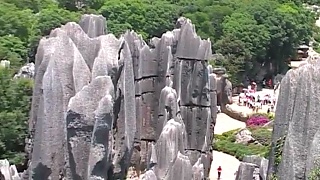
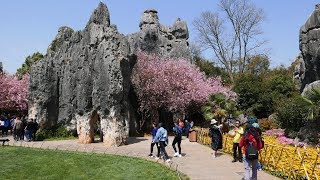
Stone Forest (Shilin): Located about 90 kilometers southeast of Kunming, the Stone Forest is a UNESCO World Heritage Site known for its surreal limestone formations resembling a forest of stone pillars. Visitors can explore the maze-like paths, visit local villages, and learn about the Yi ethnic minority culture.

Dianchi Lake: Kunming's largest lake offers scenic views, waterfront parks, and recreational activities such as boating and fishing. Nearby attractions include the Yunnan Nationalities Village, where visitors can learn about the diverse cultures of Yunnan's ethnic minority groups.

Jiaozi Snow Mountain: This scenic area northwest of Kunming features snow-capped peaks, alpine meadows, and hiking trails. Visitors can take a cable car ride to enjoy panoramic views of the surrounding landscape.

Cultural and Historical Sites:
Yuantong Temple: Dating back over 1,200 years, Yuantong Temple is one of the oldest and most important Buddhist temples in Kunming. It features traditional architecture, serene gardens, and ornate halls with Buddhist statues and artifacts.

Kunming Old Street (Guandu Ancient Town): Explore the historic streets and traditional architecture of Guandu Ancient Town, located on the outskirts of Kunming. Highlights include the Guandu Old Bridge, temples, and local markets.

Ethnic Minority Culture:
Yunnan Ethnic Village: This cultural theme park showcases the diverse traditions, customs, and architecture of Yunnan's ethnic minority groups, including the Yi, Bai, Dai, and Hani people. Visitors can watch cultural performances, shop for handicrafts, and sample ethnic cuisine.

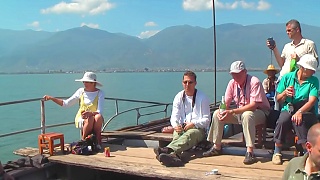
Golden Temple (Jin Dian): Located on Mingfeng Hill, the Golden Temple is a Taoist temple complex known for its large copper pavilion covered in gold leaf. It offers panoramic views of Kunming and the surrounding countryside.

Modern Attractions:
Green Lake Park (Cuihu Park): This urban park in central Kunming is a popular recreational spot for locals and tourists alike. It features scenic walking paths, pavilions, gardens, and a variety of bird species.

Daguan Park: Known for its expansive lake and picturesque views of the Western Hills, Daguan Park is a tranquil retreat from the city's hustle and bustle. Visitors can stroll along the lakeside promenade, enjoy traditional tea houses, and admire the park's classical Chinese architecture.

Practical Tips:
Transportation: Kunming has a well-developed public transportation system, including buses and the Kunming Metro. Taxis and ride-hailing services are also widely available.

Weather: Kunming enjoys a mild climate year-round, but it can be cool and rainy in the winter months. It's advisable to check the weather forecast and pack accordingly.

Language: Mandarin Chinese is the official language, but English may not be widely spoken outside of tourist areas. It's helpful to learn a few basic phrases or carry a translation app, especially when interacting with locals from ethnic minority groups.

Kunming's blend of natural beauty, cultural diversity, and historical charm makes it a fascinating destination for tourists. Whether you're exploring ancient temples, admiring stunning landscapes, or immersing yourself in ethnic minority culture, Kunming offers a unique and memorable experience for visitors of all interests.
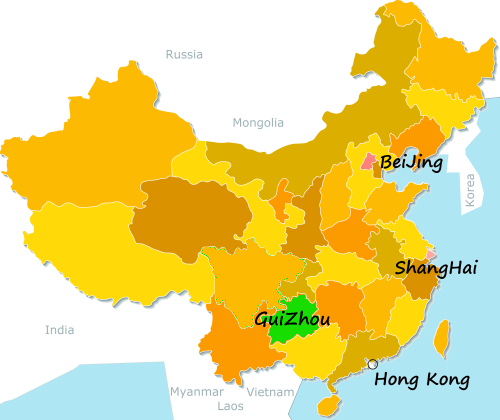
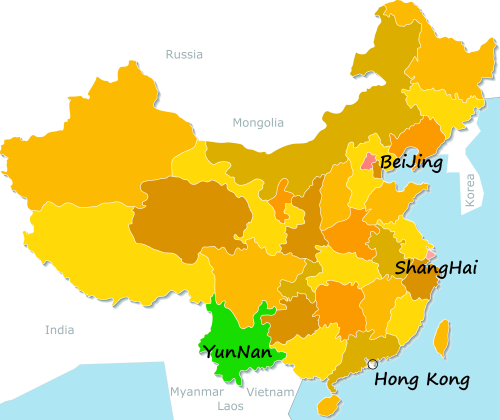
GuiZhou map
YunNan map

Related Videos


Featured Videos

US planning the destruction of Taiwan
With Redacted ... With Brian Berletic, Angelo Giuliano and Danny HaiPhong ... With Reportify Media and George Galloway ...
Confucius – wisdom that is ageless
Cyber-punk mega-city ChongQing
With No Idea But Here ...
NanLuoGuXiang hutong walk, BeiJing
A day trip to the Summer Palace 頤和園 in BeiJing
Filmed in November 2011.
Why is Western media so biased against China ?
With Cyrus Janssen ... Comment by Gustavo Andrés ... There is an overwhelming assumption in the West that China’s Achilles heel is the state: that it lacks legitimacy. This is the underlying reason why Westerners believe that China’s transformation is unsustainable: that the political system cannot survive. It would be wrong to suggest that attitudes have not shifted: the endurance of the reform period, now over 35 years old, and the scale of its achievement have bred a growing if still grudging respect, and a less apocalyptic view of Chinese political change. Few now regard it to be imminent and many have extended their time horizons somewhat into the future. Nevertheless, most Westerners still regard China’s present political order as lacking legitimacy and as ultimately unsustainable. In the post 1945 period, Westerners have come to believe that Western-style democracy – essentially universal suffrage and a multi-party system – is more or less the sole source of a government’s legitimacy. This is a superficial and ahistorical position. Western-style democracy does not ensure the legitimacy of a regime in the eyes of its people: Italy is perhaps the classic example, with successive governments over a long historical period experiencing a chronic lack of legitimacy. And what of China? Although it does not have Western-style democracy, there is plenty of evidence – for example the Pew Global Attitude surveys and the work of Tony Saich at the Harvard Kennedy School – that the Chinese government enjoys high levels of support and legitimacy, much higher indeed than those of Western governments. How do we explain this? Clearly the reason is not Western-style democracy because China has not chosen this path. The late Lucian W. Pye, in his book ‘Asian Power and Politics’, argues that Western scholars have, in their understanding of politics, prioritised political systems over political cultures: Pye argues, correctly in my view, that the opposite is the case. His insight is highly relevant to the Chinese case. The relationship between the state and society in China is very different from that which characterises Western societies. There are three key elements. First, China is primarily a civilization-state rather than a nation-state, with the overriding and extremely difficult age-old task of government being to maintain the unity of China and its civilization. This has lent the state an enduring authority, importance and centrality in China that is very different from the Western nation-state tradition. The state is intrinsic to China in a way that this is not true in Western societies: they are, in effect, in large degree synonymous. Furthermore the Chinese regard the state in some degree as an expression and extension of themselves. Second, whereas in Western societies the state is seen in an instrumentalist and utilitarian way – in other words, what will it do for me? – in China, following from the Confucian tradition and the idea that the Emperor should model himself on the father’s role as the head of the family, the state is perceived in a familial way, whence the expression ‘nation-family’, or the idea of China as an extended family. Or, to put it another way, in Western societies the state is viewed as an external and somewhat artificial construct, for the Chinese it is an intimate. Third, a much higher premium is placed on the efficiency and efficacy of the state than in the West, whence the importance of meritocracy in the recruitment of public servants. In the West, discussion about the state largely revolves around the manner by which the government is selected, in China, by way of contrast, the competence of the state assumes priority. Fourthly, following from the previous point, the state is expected and required to deliver in China. Over the last few decades, of course, it has presided over and masterminded a huge transformation, the most remarkable in modern economic history. The contrast between the performance of the Chinese and Western economies is manifest. In summary, the relationship between the state and society in China and the West is profoundly different and the reasons lie in the historical and cultural differences between them. They can and should learn from each other but they will remain distinct. So what of the future? As I mentioned at the outset, it is axiomatic in the West that sooner or later China will face a crisis of governance that will result in profound reform along Western lines. In reality, it seems far more likely that the crisis of governance will occur in the West than China. The United States and Europe are in decline and, as a consequence, their ruling elites and political systems are already suffering from declining legitimacy and authority, a process that is likely to continue. China, in contrast, is a rising power whose ruling elite is likely to enjoy growing status and prestige as a consequence. China, though, faces its own kind of governance challenge. The country is changing at extraordinary speed. If one thinks of how the life of an ordinary person has changed over the course of the last three decades, then this is a measure of how everything else, including political rule, must also change in order to survive. Of course, transparency, representivity and accountability have been transformed since Mao’s death, but this is a dynamic process and arguably the greatest changes still lie in the future. It is not that China needs to or should change its system – it has stood the test of time and managed to stay abreast of and lead the wider transformations – but, this notwithstanding, more profound ways must be found to modernise the political system and its institutions if they are to meet the demands and expectations of a very different society.
Exploring beautiful YunNan 云南 province
Including DaLi 大力, LiJiang 丽江, Tiger Leaping Gorge 虎跳峡 and ChengDu 成都. A great film - don't miss it ...
This is Beijing 北京 !
A film of beautiful Beijing by our resident photographer, plus more great films. 9 minutes to see the beautiful, blue sky city of Beijing ...
ChangSha night walk, HuNan province
With Walk East ...

Tag search ?