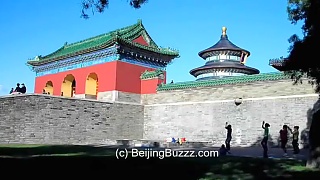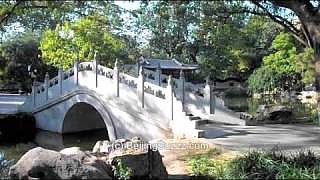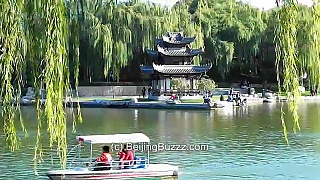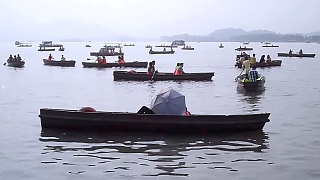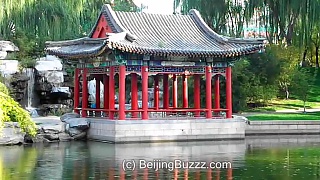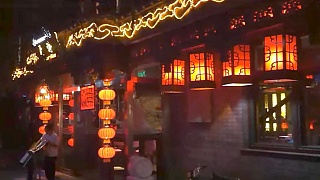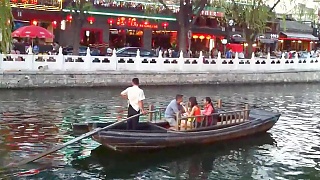
Early morning at QianHai 前海 Lake, BeiJing

About 7am.

QianHai is the lake between HouHai and BeiHai Park (across Di'AnMen street) and includes Lotus Lane along the south west side, with lake-side bars and dining.


XiHai, HouHai and QianHai are collectively known as ShiChaHai. All three have interesting places to eat and drink, and are particularly popular at night.


Between HouHai and QianHai lies the ancient JinDing bridge (JinDing Qiao); from the east side one can follow the interesting pedestrianised lane YanDaiXie Jie to the Drum and Bell Towers. Parallel to QianHai a little further east lies Nan LuoGuXiang.


[640],shadow=true,start=,stop=

Beijing, the capital city of China, is a vibrant metropolis steeped in history, culture, and modernity. Here's a brief overview of what you can expect as a tourist in Beijing:

Historical Landmarks:
The Great Wall of China: One of the most iconic structures in the world, the Great Wall is easily accessible from Beijing. Mutianyu and Badaling sections are popular among tourists.

Forbidden City (Palace Museum): A UNESCO World Heritage Site, this vast imperial palace complex was home to Chinese emperors for over 500 years. It houses numerous halls, courtyards, and historical artifacts.

Temple of Heaven: A masterpiece of Chinese architecture, this ancient temple complex served as a place of worship for emperors to pray for good harvests.

Summer Palace: A stunning ensemble of lakes, gardens, and palaces, the Summer Palace served as a retreat for emperors during the Qing dynasty.

Tiananmen Square: One of the largest city squares in the world, Tiananmen Square is flanked by important landmarks such as the Monument to the People's Heroes, the Great Hall of the People, and the Mausoleum of Mao Zedong.

Cultural Sites:
Beijing Hutongs: Explore the narrow alleyways and traditional courtyard residences of Beijing's historic neighborhoods. You can take a rickshaw tour or simply wander around on foot.

Beijing Opera: Experience traditional Chinese opera performances at venues like the Liyuan Theater or the Chang'an Grand Theatre.

798 Art District: A hub of contemporary art and culture, this former industrial area is now home to numerous galleries, studios, and cafes.

Modern Attractions:
Olympic Park: Visit iconic structures such as the Bird's Nest (National Stadium) and the Water Cube (National Aquatics Center) from the 2008 Beijing Olympics.

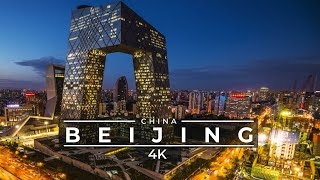
CBD (Central Business District): Marvel at the futuristic skyline of Beijing's modern business district, which includes landmarks like the CCTV Headquarters and the China World Trade Center Tower III.

Culinary Delights:
Peking Duck: Indulge in Beijing's most famous dish, crispy roast duck served with pancakes, scallions, and hoisin sauce.

Street Food: Explore the city's vibrant street food scene and sample local delicacies like jianbing (savory crepes), lamb skewers, and dumplings.

Practical Tips:
Transportation: Beijing has an extensive public transportation system, including the subway, buses, and taxis. However, traffic can be heavy, so plan your travels accordingly.

Language: While English is not widely spoken, especially outside tourist areas, many signs and transportation announcements are in English. It's helpful to carry a translation app or a phrasebook.

Weather: Beijing experiences four distinct seasons, with hot summers and cold winters. The best times to visit are spring (April to June) and autumn (September to October) when the weather is mild and comfortable.

Etiquette: Respect local customs and traditions, such as removing your shoes before entering someone's home and using both hands to pass or receive items.

Beijing offers a rich tapestry of experiences for tourists, blending ancient heritage with modern innovations. Whether you're fascinated by history, culture, or culinary delights, there's something for everyone in this dynamic city.
Related Videos


Featured Videos

The Asian Games 2023 – opening ceremony
HangZhou ...
The ‘Scholar’s Four Jewels’ of China – the brush, ink stick, ink slab and paper
The 'Scholar's Four Jewels' of China are the brush, ink stick, ink slab and paper. Discover how each is created from scratch, from thousands of years of cultural tradition ... While ink and paper are well-known Chinese inventions, so is movable block printing ...
Beautiful moments in GuiLin 桂林
GuangXi province, south China ...
China 中国 trip – fun-loving pandas in ChengDu, LeShan Giant Buddha, ChongQing and Mount Emei
Plus the Paradise Island Water Park in ChengDu, the Arkansas Jazz Band in ChengDu, and a lot more ... We end with a clip from 'ChongQing from the Air', starting with the city at night, and followed by the awesome natural scenery in the surrounding area, including the beautiful peaks and valleys of the Three Gorges area ... PLEASE DONATE to this site - we really need your help to keep going; see the donate button on the right. ChengDu Pandas, LeShan Giant Buddha and Mount Emei Paradise Island Water Park, ChengDu Arkansas Jazz Band, ChengDu, plus local dancers Two scenes from ChengDu ChongQing from the air
A month in China : The Great Wall of China : tour suggestion from BeiJingBuzzz
Great Wall of China Tour This itinerary takes you on a comprehensive journey along the Great Wall of China, starting from the western end in Jiayuguan and ending at the eastern end in Qinhuangdao. Week 1: Western End - Jiayuguan and Dunhuang Begin your journey at the western end of the Great Wall in Jiayuguan, Gansu Province. Explore the Jiayuguan Fort, an ancient military stronghold at the western terminus of the Ming Dynasty Great Wall. Visit the nearby Overhanging Great Wall and the First Beacon Tower to experience the rugged beauty of the western desert landscape. Travel to Dunhuang to visit the Mogao Caves and the Crescent Lake oasis, and learn about the Silk Road history of the region. Week 2: Central Section - Shanxi and Hebei Travel eastward to Shanxi Province to explore sections of the Great Wall at locations like Datong and Yanmenguan. Visit the Hanging Temple of Datong and the Yungang Grottoes, UNESCO World Heritage Sites renowned for their ancient Buddhist art and architecture. Continue to Hebei Province to visit iconic sections of the Great Wall such as Jinshanling and Simatai, known for their scenic beauty and well-preserved architecture. Week 3: Beijing and Surroundings Arrive in Beijing, the capital city of China, and explore the famous Mutianyu and Badaling sections of the Great Wall. Visit other historical and cultural attractions in Beijing, such as the Forbidden City, Tiananmen Square, and the Temple of Heaven. Take day trips to lesser-known sections of the Great Wall, such as Huanghuacheng and Jiankou, for a more secluded experience. Week 4: Eastern End - Liaoning and Hebei Travel northeast to Liaoning Province to visit sections of the Great Wall at locations like Shanhaiguan and Jinzhou. Explore the Old Dragon's Head, where the Great Wall meets the Bohai Sea, and visit the nearby Shanhaiguan Pass, known as the "First Pass Under Heaven." Return to Hebei Province to visit the eastern terminus of the Great Wall at Laolongtou (Old Dragon's Head) in Qinhuangdao.
Night walk in YangShuo 阳朔
With Walk East ...
Beautiful YiChang 宜昌, HuBei province
Includes the Three Gorges Dam.
Something different – more about narcissism (psychology)
At root, narcissism ('life is all about me') is self-loathing projected onto someone else (the scapegoat, who might be driven to death - through illness, madness, suicide; let's call it what it is - emotional torture; in contrast, all others are shown a completely opposite, OTT, 'lovely' persona; and many will be deceived by this). Narcissism is very destructive; and not often recognized. This is not a rare thing; it could well be 1 in 5 people. Don't miss this; Dr. Ramani is awesome. Ramani Durvasula in conversation with Lewis Howes ... Narcissistic fathers and the damage they do to their children ... Narcissistic mothers and the damage they do to their children ... Narcissism and society ... On how a narcissist will try to destroy you ... Is your depression a symptom of being in a narcissistic relationship? Relationships need some work, including self-reflection; but they shouldn't be hard work - that's a sign it might never work out; if one feels a need to be treading on egg shells, that's confirmation it is doomed. Real relationships are based on mutual respect, flexibility and compassion (unconditional love - no ifs or buts)*; narcissists have none of these attributes. In a time of stress, does the other stay positive and chip in, or start a blame game? Things like this are the signs to look out for. Does the other help you reach your dreams, or belittle you ? Are they present in the moment or in their own little bubble ? A narcissist can't stand your success or happiness. Psychopathologies are all about distortions between reality and self, between inner self and behavior. When there is the absence of such distortions - masks, projections, defense mechanisms, etc., there is authenticity. That's going from acting, to really living. * without needing that person, or allowing oneself to be walked upon. One must be at least somewhat authentic / love oneself first; not trying to complete oneself, etc.
ChangZhou 常州, JiangSu province

Tag search ?