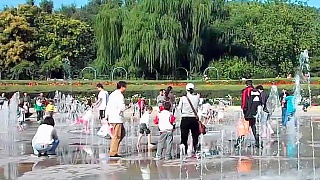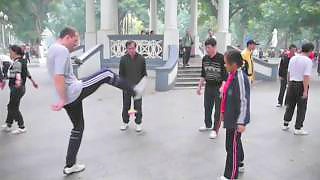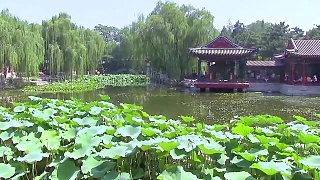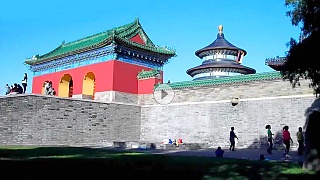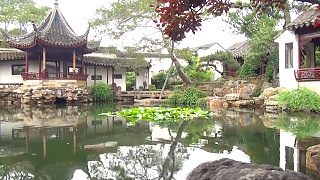
JianZi at the Temple of Heaven, BeiJing 北京

JianZi is a popular park activity in China.


[640],shadow=true,start=,stop=

Beijing, the capital city of China, is a vibrant metropolis steeped in history, culture, and modernity. Here's a brief overview of what you can expect as a tourist in Beijing:

Historical Landmarks:
The Great Wall of China: One of the most iconic structures in the world, the Great Wall is easily accessible from Beijing. Mutianyu and Badaling sections are popular among tourists.

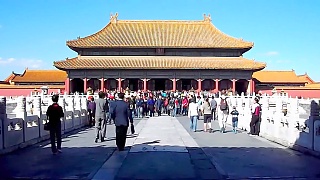
Forbidden City (Palace Museum): A UNESCO World Heritage Site, this vast imperial palace complex was home to Chinese emperors for over 500 years. It houses numerous halls, courtyards, and historical artifacts.

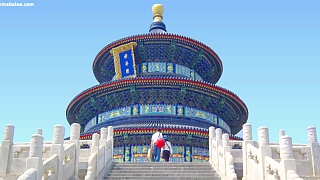
Temple of Heaven: A masterpiece of Chinese architecture, this ancient temple complex served as a place of worship for emperors to pray for good harvests.

Summer Palace: A stunning ensemble of lakes, gardens, and palaces, the Summer Palace served as a retreat for emperors during the Qing dynasty.

Tiananmen Square: One of the largest city squares in the world, Tiananmen Square is flanked by important landmarks such as the Monument to the People's Heroes, the Great Hall of the People, and the Mausoleum of Mao Zedong.

Cultural Sites:
Beijing Hutongs: Explore the narrow alleyways and traditional courtyard residences of Beijing's historic neighborhoods. You can take a rickshaw tour or simply wander around on foot.

Beijing Opera: Experience traditional Chinese opera performances at venues like the Liyuan Theater or the Chang'an Grand Theatre.

798 Art District: A hub of contemporary art and culture, this former industrial area is now home to numerous galleries, studios, and cafes.

Modern Attractions:
Olympic Park: Visit iconic structures such as the Bird's Nest (National Stadium) and the Water Cube (National Aquatics Center) from the 2008 Beijing Olympics.

CBD (Central Business District): Marvel at the futuristic skyline of Beijing's modern business district, which includes landmarks like the CCTV Headquarters and the China World Trade Center Tower III.

Culinary Delights:
Peking Duck: Indulge in Beijing's most famous dish, crispy roast duck served with pancakes, scallions, and hoisin sauce.

Street Food: Explore the city's vibrant street food scene and sample local delicacies like jianbing (savory crepes), lamb skewers, and dumplings.

Practical Tips:
Transportation: Beijing has an extensive public transportation system, including the subway, buses, and taxis. However, traffic can be heavy, so plan your travels accordingly.

Language: While English is not widely spoken, especially outside tourist areas, many signs and transportation announcements are in English. It's helpful to carry a translation app or a phrasebook.

Weather: Beijing experiences four distinct seasons, with hot summers and cold winters. The best times to visit are spring (April to June) and autumn (September to October) when the weather is mild and comfortable.

Etiquette: Respect local customs and traditions, such as removing your shoes before entering someone's home and using both hands to pass or receive items.

Beijing offers a rich tapestry of experiences for tourists, blending ancient heritage with modern innovations. Whether you're fascinated by history, culture, or culinary delights, there's something for everyone in this dynamic city.
Related Videos


Featured Videos

Cycling and bamboo rafting near YangShuo 阳朔, GuangXi province
China – 70 years of the Peoples’s Republic – and the developing world
Martin Jacques, Hannah Ryder and David Monyae (with emphasis ob Africa) ... (Note : a few audio issues here and there)
A trip to ZhangJiaJie 张家界, HuNan province
A beautiful National Forest park and renowned scenic area. Includes the world's longest cable car ride (7 km), up through the clouds ...
What is China really like – fact and fiction
An interesting interview that looks into Western propaganda ... Bonus film - a talk by professor Kishore Mahbubani ...
BeiJing’s hutongs
With Aaron and Char ... With Beyond A to B ... With DS Travel ... With Travelogue ...
Communicating in China
If you have not yet been to China, how to communicate might be a concern. This video is by a popular travel blogger discussing just this, after six months in China ...
Russell Brand on the US war plans for Taiwan – DON’T MISS IT
The world wants to be free of Western slavery, and its propaganda and bombs. Even just the far east, think of the hundreds of thousands of bombs dropped on Vietnam, Korea, Laos, Cambodia. The hundreds of military bases encircling China. And the trade war. The West plans the destruction of Taiwan. The West is not going to 'save' Taiwan; it is going to destroy it. The US never has any other country's interest at heart; it is solely about keeping them down, to be merely a slave. It is never about peace; it is only ever about dominion; think 'protection racket'. Don't be fooled again ! A must see ... In China, the people are family. In the West, the people are merely livestock.
On human rights, propaganda and trade – don’t miss it
With Jerry's Take on China ... YT comment : "It is win-win versus win-lose. Two very different mindsets". YT comment : "Propaganda is about decoupling what people 'know' from reality. Insanity is believing your own propaganda". YT comment : "A bully does not want competition at all. Rules are always bend to suit their own agenda and arms are twisted to coerce who is the big daddy on the playground. Moreover deploying half truth tactics or false flags to raise fear are common tactics in their playbook." YT comment : "Fear is the only reason the U.S. wanted to contain China. When tariffs failed, technology sanctions followed. When both tariffs and sanctions failed, de-coupling became the buzzword. And when de-coupling was found to hurt the U.S. economy more than China's, it was changed to de-risking which in effect means a "slow de-coupling" until a more appropriate time. And now, fear has invaded European minds and the Europeans want to adopt the American low-life tactics. Twenty years ago, American muscle cars and reliable Japanese cars plus reputable German, French and Swedish cars and even newbies from South Korea were selling like hot cakes in the Chinese market and each and every maker made a fortune in China. Nowadays, however, the U.S. has no hope of selling anything to China -- not only industrial products but also agricultural produce which are easily replaced by many other countries around the globe. Sooner or later, the world will be divided into 2 camps: one that embraces worldwide integration and the other a closed economy that fears competition. The acceleration of the de-dollarization movement will speed up the divide even further, to the point that it may break the world monetary system in half." Bonus films - on China's economy - with Peter Walker and Thinkers Forum ... On the Belt and Road Initiative and how it shows China's vision for Development - with BRIX Sweden and Stephen Brawer ...
White radish 白萝卜 – growing, pickling and cooking
A mild-flavored winter radish usually characterized by fast-growing leaves and a long, white, napiform root. It is similar in appearance to fresh horseradish but packs a lighter peppery punch similar to watercress. Unlike other radishes, it is as good cooked as it is raw. A very beautiful film and culinary masterclass with LiZiQi 李子柒. Dishes include SiChuan pickles, NorthEast sauerkraut and several types of XianCai, salty side-dish, and SuanCai, sour cabbage, with spice and without. Similar to Korean kimchi - Korean is one of the 56 ethnic groups in China. Don't miss it ... Rimo Z : 0:23 Rapeseed flowers 2:50 White Radish 3:37 Carrot 4:31 Chinese Cabbage 6:03 Mustard, then dehydrate the vegetables 7:58 Smear chilli sauce 8:28 Sealed for 1 month 8:51 Pine leaves for smoking the meat (Bacon) 9:03 Orange or clementine 9:10 Pomelo on the tree 9:22 Start smoking the sausage and meat 9:30 Add the pomelo and orange peel to enrich the flavor 10:16 Add salt and chilli powder, start pickling the dehydrated radish and carrots 10:36 Dried fish 11:58 put the dried fish, sausage and meat (or bacon) for boiling before eating or further cooking, this step helps to clean the food and reduce the salt 12:47 stir fry with ginger and then start stewing with green onion and orange peel 13:34 Fermented pickle cabbage (non-spicy) 13:49 Fermented pickle cabbage (spicy) 14:06 Minced meat with oil, spice powder, green onions, soy sauce, ginger and 14:14 hot oil to increase the aroma 14:26 Chop the pickle Chinese cabbage 14:38 Mix the minced meat and pickled cabbage, start making dumplings 15:53 Cut the salted meat, stir fry with green onion and stew with the dried vegetables 15:52 Add spicy pickled cabbages 16:16 Add some hot oil on top of the pickle dishes to excite the fragrance 16:42 Cut the boiled sausage, salted meat etc. 17:49 Looks like rose tea 17:55 Just white congee 米老鼠 : Kimchi first appeared in the book of songs. It was interpreted as sauerkraut in China. Korean kimchi originated in the Tang Dynasty. Tang Dynasty general Xue Rengui was assigned to Korea (today's Korea) by the government to settle down in Korea. Many of his entourage were from Jiangbei County, Chongqing, who could make kimchi in his hometown. Since then, Chongqing kimchi has entered Korea. Several wars in Korea have brought this kind of dish into Korean civilian families. Kimchi went through several stages before it became the real Korean kimchi. The first stage is the Three Kingdoms period, when the pickled dishes or radish, cucumber, etc., introduced to South Korea after adding leeks and other fresh vegetables. In the second stage, in the Korean period, the production methods began to be enriched, and the raw materials were added to the base. The third stage is that cabbage has become the main raw material, which is what we eat now.

Tag search ?